CFTS Quality Assurance Procedural Code
How do you know that a Thorough Examination is genuinely thorough?
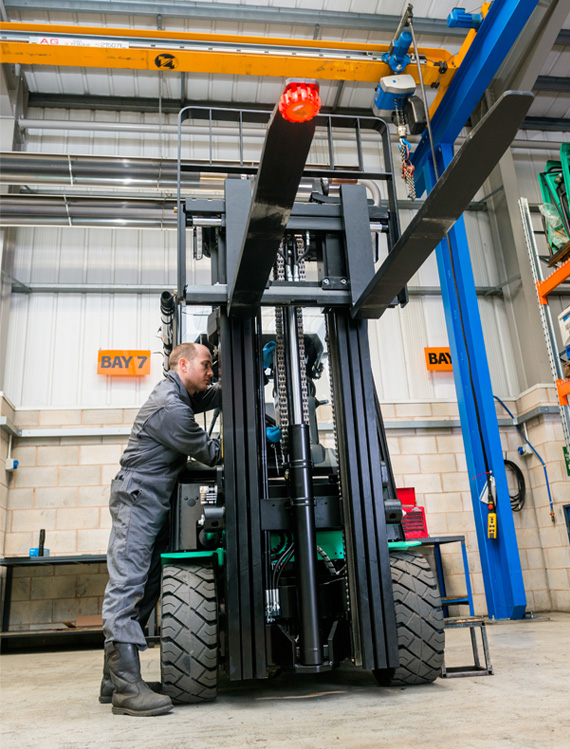
That the engineer who carried it out was properly qualified? That the report you received is independent, accurate, and worth the paper it's printed on?
The answer is the CFTS Quality Assurance Procedural Code.
Every company accredited to CFTS must sign up to this 20-section document in full. It sets out — precisely and in detail — the standards that all CFTS-accredited companies and registered competent persons must meet at every stage of the Thorough Examination process. From the qualifications of the engineer to the independence of the report. From the equipment they carry to the way complaints are handled.
CFTS makes the Code freely available to download. Anyone commissioning a Thorough Examination can read it and see exactly what they should be getting.
To read the Code as a PDF, click here.
The foundation: UKMHA Guidance Note GN28
The Code is built on UKMHA Guidance Note GN28 — Thorough Examination and Safety Inspections of Industrial Lift Trucks — developed by the Technical Policy Committee, whose members include Chartered and Incorporated Engineers and Members of the Institution of Engineering and Technology.
GN28 is the technical reference standard for how a Thorough Examination of an industrial lift truck should be conducted. The CFTS Quality Assurance Procedural Code takes GN28 as its examination framework and surrounds it with the quality assurance, training, independence, and administrative requirements that turn a document into a deliverable standard.
Where equipment is not covered by GN28 — for example, boom-type MEWPs — the same principles are applied.
What a competent person must meet
Not everyone can carry out a Thorough Examination under the CFTS scheme. Section 9 of the Code sets out precise requirements for every registered competent person:
- A minimum of five years' experience as a service engineer in a relevant sector — which may include appropriate apprentice training
- The capability to inspect a full range of equipment for safety-critical items, including all hydraulics, braking systems, steering systems, traction systems, safety systems, and general structure
- Completion of a Thorough Examination course approved by CFTS
- Authorisation as a competent person by their current employer
- Attendance at a revalidation course at least every five years, provided by a CFTS-approved body
Only named personnel who have attended an approved training centre are permitted to carry out Thorough Examinations under the CFTS scheme. Every competent person's experience and qualifications are uploaded to the CFTS database for assessment and authorisation — and must be kept current.
This is not a self-certified standard. The qualifications are verified. The training is independently assessed.
What a Thorough Examination body must have
The Code doesn't just regulate individual competent persons. It regulates the companies that employ them. Every CFTS-accredited Thorough Examination body must:
- Have a minimum of two persons — a Thorough Examination Manager and at least one competent person
- Designate a Thorough Examination Manager with either a minimum of two years' experience as a CFTS-accredited competent person, or completion of a CFTS-approved TE Manager course (revalidated every five years)
- Maintain documented training records for all personnel involved in Thorough Examinations
- Hold appropriate insurance for its level of business
- Use only CFTS-authorised documentation — either paper or electronic
- Only sub-contract Thorough Examinations to other companies registered with CFTS
Independence and impartiality
Section 5 of the Code addresses something that matters more than most people realise: the independence of the examination from the repair and maintenance function.
A competent person's remuneration must not depend on the number of examinations carried out or their results. They must be free from commercial, financial, or other pressures that could affect their judgement. If approached with any benefit or reward in relation to an examination, they must refuse and report it immediately.
The examination must be conducted and reported separately from any routine maintenance or repair work. Where the same engineer both examines and services a truck, the examination must be completed and documented first — before any other work begins. The Report of Thorough Examination must reflect the condition of the equipment at the time of examination, not after it has been repaired.
For small companies, the Code is specific about what is acceptable: splitting the fleet so that different competent persons examine and maintain different trucks, or designating one or two persons solely for Thorough Examinations. The principle is clear — a competent person should not normally examine equipment they regularly repair or maintain.
Quality assurance and the 1% check
The Code requires every accredited company to carry out a system of planned, documented internal quality audits at least once a year. Quality assessments must be completed following any significant change within the company, and more frequently if quality issues have been identified.
A key requirement of the quality management system: 1% of all Thorough Examinations must be re-examined — either by the Thorough Examination Manager conducting a re-examination, or by arranging for a different competent person to re-examine the equipment. This is a concrete, measurable quality control standard. It is not common to inspection schemes outside CFTS.
All Thorough Examination reports must be completed within 48 hours of the examination and retained for a minimum of two years (or five years for equipment in the Republic of Ireland, in line with the Safety, Health and Welfare at Work (General Application) Regulations 2007).
On an annual basis, all members must log in to the CFTS website to confirm they are adhering to the current Code and to update their company and competent person details.
What the report must do
Under Section 12 of the Code, the Report of Thorough Examination must:
- Be completed in a form authorised by CFTS
- Identify all safety-related defects found and specify timescales for remedying them
- Be signed by the competent person
- Confirm whether the equipment is safe to remain in service until the next examination
- Where defects represent an imminent danger, clearly state this and recommend withdrawal from service
- Be accompanied, at the time of inspection, by a label affixed to the equipment showing the exact date the next Thorough Examination is due
Where a defect in the lifting equipment involves an existing or imminent risk of serious personal injury, a copy of the report must be sent to the relevant enforcing authority — HSE for factory and manufacturing sites and lease/rental trucks, or the local authority for retail, warehousing, and distribution sites.
Accreditation and arbitration
Companies wishing to apply for CFTS accreditation must provide detailed information about the staff who will carry out Thorough Examinations, their facilities, equipment, and training programmes. They must commit to the full requirements of the Code and accept independent assessment and a formal complaints procedure.
Where accreditation is refused or disputed, a formal two-stage arbitration process applies — first with CFTS's Technical Manager, then, if unresolved, with RTITB as an independent arbitration body. There are no costs to the company lodging a grievance other than travel.
Find a CFTS-accredited examiner near you
